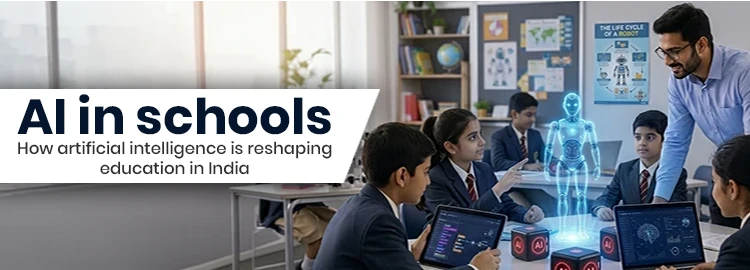
AI in schools: How artificial intelligence is reshaping education in India
The conversation around artificial intelligence has moved well beyond the technology sector. Healthcare, finance, retail and, increasingly, education are all feeling the shift. For schools, this presents a genuine opportunity to personalise learning, reduce administrative burden and better support both students and teachers.
It also brings with it a set of questions that deserve serious and unhurried consideration: about equity, about data, about the irreplaceable role of the human teacher, and about what education actually is when the process of arriving at an answer can be automated.
This is not a blog that takes a position of uncritical enthusiasm or reflexive alarm. It is an attempt to look at both sides of the conversation honestly, because schools that engage with AI thoughtfully will be far better served than those that either rush in without a framework or hold back without a reason.
What AI is already doing inside school walls
AI in education is not a future-facing concept. It is already operating inside everyday school functions, from adaptive learning platforms that adjust content in real time to administrative systems that manage attendance, fees and parent communication more efficiently.
What this change actually looks like in practice, and what it genuinely offers, is the more useful question for school leaders to start with.
The opportunities AI is opening up for schools
1. Personalised learning at scale
One of the most significant advantages AI brings to education is the ability to treat students as individuals within a system that has traditionally operated at a single pace for all. A classroom of thirty students contains thirty different learning trajectories, and a single teacher cannot realistically track and respond to each of them simultaneously.
AI-powered learning tools can identify where a student is struggling, adjust the difficulty of content in real time and offer targeted practice that addresses specific gaps rather than covering ground the student has already mastered. For students who learn faster or slower than the class average, this kind of responsiveness can make a measurable difference to both their confidence and their outcomes.
2. Stronger support for teachers
The administrative load carried by teachers in most schools is significant, and it competes directly with the time and energy available for actual teaching. Automated grading, attendance tracking, lesson plan suggestions and progress reporting are all areas where AI can return hours to a teacher’s week.
Beyond administration, AI tools that analyse performance patterns across a class can give teachers a more detailed and timely picture of where students are than a quarterly assessment cycle alone ever could. The insight that a particular student has been consistently struggling with reading comprehension for six weeks is far more actionable when it arrives in week two.
3. Early identification of learning difficulties
Assessment cycles in most schools are periodic. A student can fall behind quietly for months before the difficulty becomes visible in a formal result. AI systems that track performance continuously can surface these patterns far earlier, flagging where intervention might be needed before small gaps compound into larger ones.
Early identification means earlier support, and earlier support has a direct and documented impact on long-term student outcomes. In larger classrooms especially, where a teacher’s attention is necessarily distributed, this kind of early-warning capacity is genuinely valuable.
4. Smarter school administration
The operational complexity of running a school at scale is considerable. Fee management, admissions, staffing, resource allocation, parent communication: these are areas where human attention is expensive and error-prone and where well-designed technology can make a meaningful difference.
Predictive analytics that help school leadership make more informed decisions about admissions trends or staffing needs, automated systems that handle routine parent communication, administrative dashboards that give leadership a real-time view of school operations: these are not aspirational features. They are already in use in well-managed school networks, and they free leadership to spend more time on the decisions that genuinely require human judgement.
The challenges schools need to think carefully about
1. Equity of access
The benefits of AI in education are not evenly distributed, and this is the first challenge that any honest conversation about AI in Indian schools must acknowledge. Schools in urban centres with reliable internet connectivity and well-funded technology infrastructure are far better positioned to implement these tools than schools in rural or semi-urban areas where basic digital infrastructure may still be limited.
For AI to genuinely improve education outcomes across India, access cannot be the privilege of a few well-resourced institutions. Schools, policymakers and education service providers all have a role to play in ensuring that the benefits of technology reach every classroom, not just the best-equipped ones.
2. Data privacy and security
AI systems are built on data, and in a school environment, that data involves children. Student performance records, behavioural patterns, communication logs and personal details all feed into AI platforms, raising legitimate questions about storage, access and protection.
Schools adopting AI tools need clear data governance policies in place and must work only with technology providers who meet robust security standards. Parents also deserve full transparency about how their child’s data is being used, who has access to it and what happens to it when a contract ends or a platform changes.
3. The risk of over-reliance on technology
Education is not simply the transfer of information. It involves mentorship, empathy, moral development and the kind of relationship-building that only happens between people. There is a real risk that an over-enthusiasm for AI leads schools to prioritise screen-based learning at the expense of human interaction, critical thinking and hands-on experience.
AI should be seen as a tool that supports good teaching, not a substitute for it. Schools that use AI as one component of a broader pedagogical approach are far more likely to see positive outcomes than those that treat it as a wholesale solution to the complexity of education.
4. Teacher readiness and training
Introducing AI tools into a school without adequately preparing teachers to use them is one of the most common reasons technology adoption fails in educational settings. Teachers need structured support, not just on the mechanics of specific tools but on how to integrate them meaningfully into their existing practice and pedagogical values.
A technology budget without a corresponding training budget is an incomplete plan. Professional development that builds teacher confidence and competence with AI tools is not an optional extra: it is what determines whether the investment produces any return at all.
5. Academic integrity
The rise of AI writing and problem-solving tools has introduced new challenges around what it means to assess a student’s understanding. Essays, homework assignments and written answers that AI can produce instantly are no longer reliable measures of a student’s thinking.
Schools need to rethink assessment design, moving toward formats that emphasise original thinking, verbal reasoning, applied problem-solving and process-based evaluation over written outputs that AI can generate without the student engaging at all. This is not a minor adjustment. For many schools, it represents a fundamental rethink of how learning is measured.
What responsible AI adoption in schools actually looks like
Responsible adoption begins with intention. Schools that introduce AI with a clear purpose, defined boundaries and a commitment to ongoing evaluation are far more likely to see meaningful results than those that adopt technology reactively.
A few principles that make a practical difference:
- Start small and evaluate before scaling: Pilot one or two tools in a specific context, measure their actual impact on student outcomes and teacher experience, and use those findings to inform broader decisions. Adoption driven by evidence is more sustainable than adoption driven by momentum.
- Keep the teacher at the centre: AI should augment the teacher’s role, never diminish it. The human relationship between a teacher and a student remains the most powerful force in education, and any technology that undermines that relationship is not serving its intended purpose.
- Involve parents in the conversation: Parents deserve to understand how AI is being used in their child’s education and how their child’s data is being handled. Transparency here builds trust; opacity does the opposite.
- Invest in training alongside technology: The teachers who will get the most from AI tools are those who understand both what the tools can do and what they cannot. That understanding comes from investment in professional development, not from assuming the tools are intuitive.
The schools that will benefit most
AI in schools presents a real and significant opportunity to make education more personalised, more efficient and more responsive to the needs of individual students. But realising that potential requires schools to engage with the technology thoughtfully, equitably and with a clear-eyed understanding of its limitations.
The schools that will benefit most from AI are not necessarily those with the largest technology budgets. They are those with the clearest vision of what they want education to look like and the discipline to use every tool, human and technological, in service of that vision.
At K12 Techno Services, we work closely with school leadership to navigate exactly these questions, helping schools integrate technology into academics, administration and operations in ways that are practical, sustainable and aligned with each school’s specific goals.
If you would like to explore how we can support your school’s journey, we would welcome the conversation. Get in touch with the K12 Techno Services team to explore how we can support your school.
Empowering Schools Across India
Get in touch with our team to find the right solution for your school’s needs.
Recent Blogs

In Depth Guide…
Opening a school in India is a crucial undertaking that demands careful planning, substantial funding…