Few institutions carry the operational load that a school does. In a single day, leadership may oversee attendance for several hundred students, respond to a transport delay, address fee queries from parents, arrange cover for an absent teacher and prepare documentation for a regulatory inspection. All of these tasks run alongside the core responsibility of delivering quality education.
For decades, schools managed these demands through registers, paper files and the experience of long-serving staff. The approach was effective, but only to a point. Processes were slow, errors were difficult to trace, and as enrolment increased, the administrative model struggled to keep pace. Decisions frequently depended on how quickly records could be located and compiled.
Technology has changed the situation considerably. When schools select appropriate systems and embed them into daily practice, administrative effort reduces, accuracy improves, communication with families becomes more timely and leadership gains reliable information on which to base plans for school growth.
Technology now influences almost every function within a school, including classroom instruction, fee administration, transport and admissions. Each area is addressed separately below, although in practice they are closely interconnected.
School ERP systems: The operational backbone
A school ERP (Enterprise Resource Planning) system is a centralised platform that consolidates a school’s core administrative functions. These typically include student information, attendance, timetabling, fee management, payroll, examinations, library records and internal communication.
Its principal strength is consistency. When the accounts department, the principal and class teachers all work from the same source of information, they largely eliminate discrepancies between departmental records. Errors associated with manual data entry decline, and leadership can review the school’s current position without waiting for reports to be prepared.
Scalability is equally significant from the perspective of school growth. Administering 500 students manually is demanding; administering 5,000 in the same way would require a substantial expansion of office staff. A well-designed ERP accommodates that increase with only a modest addition to the administrative team, allowing the institution to expand without a corresponding rise in operational strain.
Also read: Administrative solutions for schools: The operational backbone every school needs
Parent communication platforms: Building trust and transparency
Education research has consistently linked strong parental involvement with improved student outcomes. Technology enables schools to support that involvement in a sustained and structured way.
Parent portals and school applications give families access to attendance, academic results, fee statements, homework and school notices at any time. Parents no longer rely on scheduled meetings to understand their child’s progress, and they can identify and address concerns at an earlier stage.
There are clear operational benefits for the school as well. When parents can access routine information independently, the volume of enquiries directed to administrative staff decreases. SMS and email alerts complement these benefits by ensuring timely notification of holidays, revised examination schedules and the release of results.
Learning management systems: Supporting teaching and assessment
A Learning Management System (LMS) is a digital platform that brings together instructional content, assignments and assessments. Teachers can share lesson materials, set and evaluate work, provide feedback and monitor individual progress, while students and parents have access to the same information.
For teachers, this reduces the administrative effort involved in managing printed resources and paper-based assessment and provides a more detailed picture of student engagement and attainment. For school management, the LMS provides insight into how effectively teachers deliver learning across classes, which supports decisions on remedial intervention and curriculum review.
Also read: Teacher solutions for classroom challenges: A guide for school leaders
Smart classroom technology: Transforming the learning environment
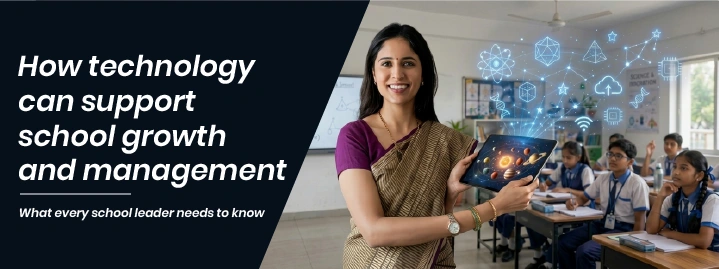
Smart classrooms are among the most visible applications of technology in schools. Interactive boards, high-quality audio-visual systems and connected devices alter the character of instruction, particularly for students who benefit from visual and interactive approaches.
Concepts such as the water cycle or atomic structure can be demonstrated through animation and simulation, which tends to support stronger understanding and retention. Tab-labs, digitally equipped science labs, aero-modelling labs and robotics labs extend the discussion further by providing dedicated environments for applied, hands-on learning. In these settings, students develop analytical thinking, problem-solving ability and technical competence through direct practice.
Smart classroom infrastructure also has a bearing on admissions. Prospective families evaluating a campus give considerable weight to learning facilities, which makes this investment relevant to growth as well as to day-to-day teaching.
Data analytics and reporting: Making better decisions
Data analytics is among the most valuable contributions of technology to school management, though it receives less attention than more visible tools.
When a school’s systems are integrated, attendance, academic performance, fee collection, staff records and operational data can be reviewed together. Leadership is then able to base decisions on evidence rather than on intuition or anecdotal observation.
School leaders routinely need answers to questions such as these: Which subjects are showing a sustained decline in results? Which grades or sections record the highest absenteeism? Where are fee collection shortfalls concentrated? Why is a particular campus within a group underperforming? Without dependable data, each of these requires extensive manual investigation. With integrated reporting, the relevant information becomes available promptly and enables action. For multi-campus school groups, this consolidated visibility provides a significant operational advantage.
GPRS and transport management: Keeping students safe
For schools that operate their transport, technology offers meaningful improvements in both safety and efficiency. GPRS tracking enables parents to view the real-time location of their child’s school bus, providing reassurance throughout the journey.
For administrators, transport management systems support route planning, driver compliance monitoring and immediate alerts in the event of delays or incidents. Transport has a direct influence on parental confidence in a school, which makes dependable, technology-supported systems in this area a sound investment.
Digital marketing and admissions technology: Supporting school growth
Sustained school growth also depends on how effectively an institution reaches and engages prospective families, much of which now takes place online.
A current and well-structured website, consistent social media presence, search engine optimisation, online enquiry forms and targeted digital advertising all improve a school’s visibility to parents actively researching options. Lead management systems ensure that every enquiry is recorded and followed up within an appropriate timeframe, reducing the loss of potential admissions.
Admissions management software simplifies the application process for families and gives the admissions office clear oversight of the pipeline. During peak admission periods, when enquiry volumes rise sharply, this allows a growing school to manage demand efficiently without a proportional increase in staff.
Technology does not, by itself, resolve the challenges a school faces. Its role is to support sound leadership and effective teaching so that both can operate at scale. Schools that select their systems carefully, implement them properly and use them consistently are well placed to grow, strengthen community trust and preserve quality throughout.
For school owners, principals and administrators planning the next phase of their institution, establishing a robust technology foundation is a present priority rather than a future consideration.
At K12 Techno Services, we provide technology support to schools across India, covering school ERP, parent communication platforms, smart classroom infrastructure, GPRS transport tracking and digital marketing. These services work together as a single integrated ecosystem, providing schools with a coherent operational foundation instead of separate, disconnected tools.
If you are evaluating how technology can support your school’s next stage of growth, we would welcome the opportunity to discuss it with you.
Get in touch with the K12 Techno Services team to discuss how we can support your school’s technology and growth strategy.