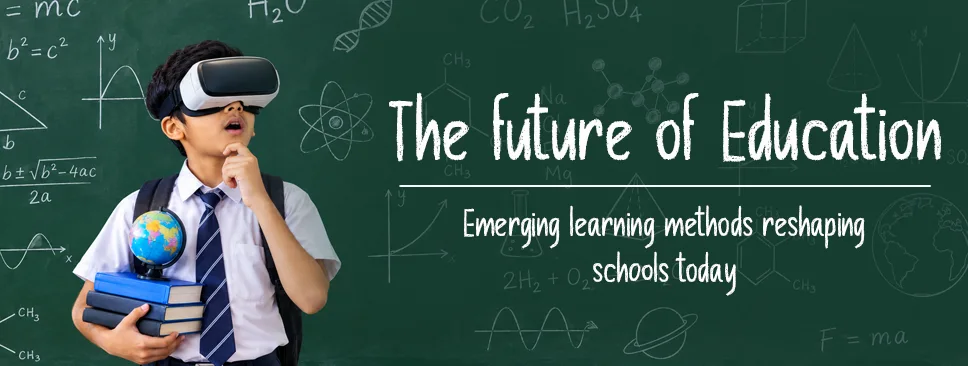
The future of education: Emerging learning methods reshaping schools today
For most of the 20th century, the model of education remained broadly consistent. A teacher delivered a lesson, students completed homework and examinations determined progress. The content changed over time, but the structure largely did not.
That model is now changing, and changing quickly. Advances in technology, a deeper understanding of how children learn and a growing recognition that the skills students will need in the future are different from those that traditional schooling was designed to produce are driving a fundamental shift in how education is being thought about and delivered.
The future of education is not something that is coming. In many schools, in India and around the world, it is already here. For school leaders who are serious about building institutions that serve every student well, understanding what it looks like and what it demands is no longer optional.
The drivers of change are multiple and interconnected.
Technology has made information universally accessible, which changes the role of the teacher from the primary source of knowledge to a guide who helps students find, evaluate and use knowledge effectively. The workplace is changing too: automation and artificial intelligence are reshaping the kinds of tasks that human workers will be expected to perform, placing a premium on critical thinking, creativity, collaboration, communication and adaptability. None of these are easily developed through rote learning and standardised testing alone.
At the same time, research in neuroscience and cognitive psychology has deepened our understanding of how children learn, revealing that engagement, emotion, relevance and social interaction all play critical roles in the learning process, and that the traditional lecture-and-test model captures only a fraction of how learning actually happens.
These forces are converging, creating both the need and the opportunity for a genuinely different approach to education. For school leaders, the question is no longer whether to engage with these changes but how to do so effectively and sustainably.
Emerging learning methods reshaping schools today
Across classrooms in India and around the world, a new set of learning approaches is taking shape. Some are technology-driven, others are rooted in pedagogy, and many are a combination of both. What they share is a common commitment to making learning more relevant, more personalised and more effective for every student.
Personalised learning
Personalised learning is the practice of tailoring the pace, content and approach of education to the individual needs, strengths and interests of each student, rather than delivering the same lesson in the same way to an entire class simultaneously.
What is new is the availability of tools and systems, including AI-powered learning platforms, adaptive assessment software and detailed student performance data, that make personalised learning achievable at scale. That means school leaders have to invest in the systems and training that make personalised approaches sustainable across classrooms and campuses. For teachers, it means better information about where each student is and what they need next.
Experiential and project-based learning
Experiential learning is built on the principle that children learn most effectively by doing, not just by listening or reading. Project-based learning, a specific form of experiential learning, involves students working on extended, real-world challenges that require them to apply knowledge from multiple subjects, collaborate with peers, manage their time and present their outcomes.
The evidence for project-based learning is strong. Students who learn through well-designed projects demonstrate deeper understanding, stronger retention and greater ability to transfer their learning to new contexts. For schools, implementing this approach requires a shift in how time, resources and assessment are structured, as well as teachers who are confident in facilitating open-ended, student-driven work. The investment is significant, but so are the outcomes.
Social and emotional learning
Social and emotional learning, commonly referred to as SEL, refers to the process through which students develop the skills to understand and manage their emotions, build positive relationships, make responsible decisions and navigate social situations effectively.
SEL is increasingly recognised not as an add-on to academic education but as a prerequisite for it. Students who are emotionally regulated and socially connected are better able to engage with their learning and perform academically. Schools that have integrated SEL into their curriculum and culture consistently report improvements in student wellbeing, behaviour and academic outcomes. For school leaders, building SEL into the fabric of school life, rather than treating it as a standalone programme, is one of the most impactful investments available.
Blended and hybrid learning
Blended learning combines face-to-face classroom instruction with online or digital learning in a way that is intentionally designed to complement and reinforce each other. The pandemic accelerated its adoption, and many of the lessons learned during that period have informed a more thoughtful integration of digital tools into classroom practice.
Blended learning, when done well, gives students more control over their learning, helps teachers use class time more effectively, and gives school leaders more data about student engagement and progress. The difference between effective and ineffective blended learning is in the intentionality of the design. Technology that serves clear pedagogical goals produces measurable learning gains. Technology adopted for its own sake does not.
Competency-based progression
Traditional schooling advances students through grades based primarily on age and the passage of time. Competency-based progression advances students based on demonstrated mastery of defined skills and knowledge, regardless of how long it takes them to achieve that mastery.
This approach has profound implications for how schools think about pacing, assessment and support. A student who has not demonstrated mastery of a foundational concept does not move on until they have, ensuring that gaps do not accumulate. Competency-based progression is more demanding to implement than traditional grade-based systems, requiring detailed curriculum mapping, robust assessment frameworks and significant flexibility in how time and resources are organised. For school leaders serious about ensuring that every student genuinely learns rather than simply advances, it represents one of the most important structural shifts available.
Interdisciplinary and integrated learning
The traditional organisation of the school curriculum into discrete subjects was designed as much for administrative convenience as for pedagogical effectiveness. The real world does not present problems in subject-shaped boxes.
Interdisciplinary learning breaks down the walls between subjects, designing experiences that draw on multiple disciplines simultaneously and help students make connections across areas of knowledge that are typically kept separate. For school leaders, moving toward integrated approaches requires curriculum redesign, teacher collaboration and a willingness to challenge structures that have been in place for a long time. For students, the payoff is learning that feels connected to the world and genuinely worth doing.
The growing role of technology in learning
Artificial intelligence, augmented reality, gamification, learning management systems and data analytics are all being applied in educational contexts in ways that were not possible even a decade ago. AI-powered platforms can personalise learning at scale. Augmented and virtual reality can create immersive experiences that bring abstract concepts to life. Learning management systems can give teachers, students and parents a shared, real-time view of progress and performance.
The caution is consistent: technology must serve clear pedagogical goals rather than being adopted for its own sake. Technology that enhances a well-designed learning experience is a powerful tool. Technology that replaces thoughtful teaching without improving outcomes is an expensive distraction. School leaders who build technology adoption around learning outcomes rather than around the technology itself are the ones who see genuine returns.
Also read: AI in schools: How artificial intelligence is reshaping education in India
What these trends mean for school leaders
For school leaders and principals, the future of education presents both a strategic and an operational challenge.
Strategically, it requires a clear vision of what kind of learning the school wants its students to experience and what kind of institution it wants to be. Operationally, it requires the systems, structures and partnerships to make that vision a reality: deliberate decisions about curriculum design, technology investment, teacher development, assessment frameworks and the physical organisation of learning spaces.
It also means being willing to evaluate existing practices honestly and change the ones that are no longer serving students well. Schools that are navigating these changes successfully are not doing so alone. Many are working with specialist education partners who bring the expertise, systems and resources needed to implement new approaches effectively and sustainably.
What these trends mean for teachers
For teachers, the future of education is both an opportunity and a challenge. Many of the emerging approaches are more intellectually engaging and professionally rewarding than delivering the same standardised lesson year after year. But they also require new skills, new approaches and a willingness to let go of familiar structures.
Teachers who are accustomed to being the primary source of knowledge in the classroom need to develop comfort with a more facilitative role. Professional development that is genuinely connected to these shifts, rather than generic training that does not address the real challenges teachers face, is essential. School leaders who invest in this kind of meaningful professional development are investing directly in the quality of learning their students receive.
What these trends mean for parents
For parents, the emergence of new learning methods raises a natural question: is my child’s school keeping pace?
The most useful thing parents can do is move beyond asking about grades and start asking about learning. What approaches does the school use to personalise learning? How does it develop social and emotional skills alongside academic ones? How is technology being used, and to what end? Schools that are genuinely engaging with the future of education will have clear and considered answers to these questions.
Building schools that are fit for the future
The future of education will not be built in a single year or through a single initiative. It will be built gradually, through thousands of deliberate decisions made by school leaders who are serious about continuous improvement and about building institutions that serve every student well.
The learning methods reshaping schools today are not trends to be observed from a distance. They are developments to be engaged with, understood and, where appropriate, implemented. The children sitting in classrooms right now deserve nothing less.
At K12 Techno Services, we work with schools across India to build the academic, operational and technological foundations that allow them to deliver education that is genuinely fit for the future. From curriculum design and teacher development to technology integration and assessment solutions, our approach is built around a deep commitment to learning that works for every student.
If you would like to explore how K12 can support your school in navigating these changes, we would welcome the conversation.
Get in touch with the K12 Techno Services team to discuss how we can support your school’s journey.